Note
Go to the end to download the full example code
Process FID nutation data
py proc_FID_nutation.py NODENAME FILENAME EXP_TYPE
Fourier transforms (and any needed data corrections for older data) are performed according to the postproc_type attribute of the data node. This script plots the result as well as examines the phase variation along the indirect dimension. Finally the data is integrated and fit to a sin function to find the optimal \(\beta_{90}\).
Tested with:
py proc_FID_nutation.py FID_nutation_1 240805_amp0p1_27mM_TEMPOL_FID_nutat ion.h5 ODNP_NMR_comp/nutation
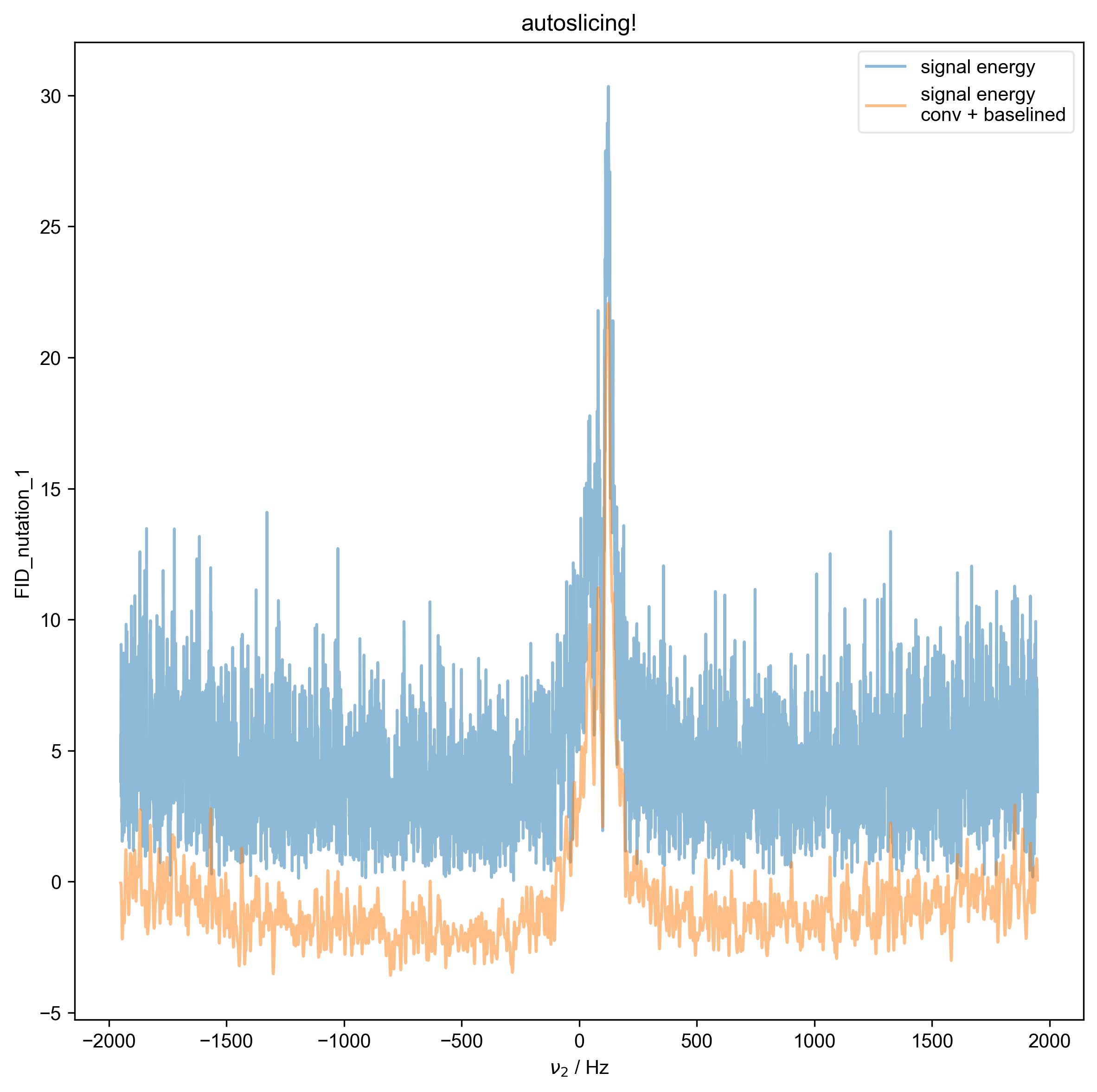
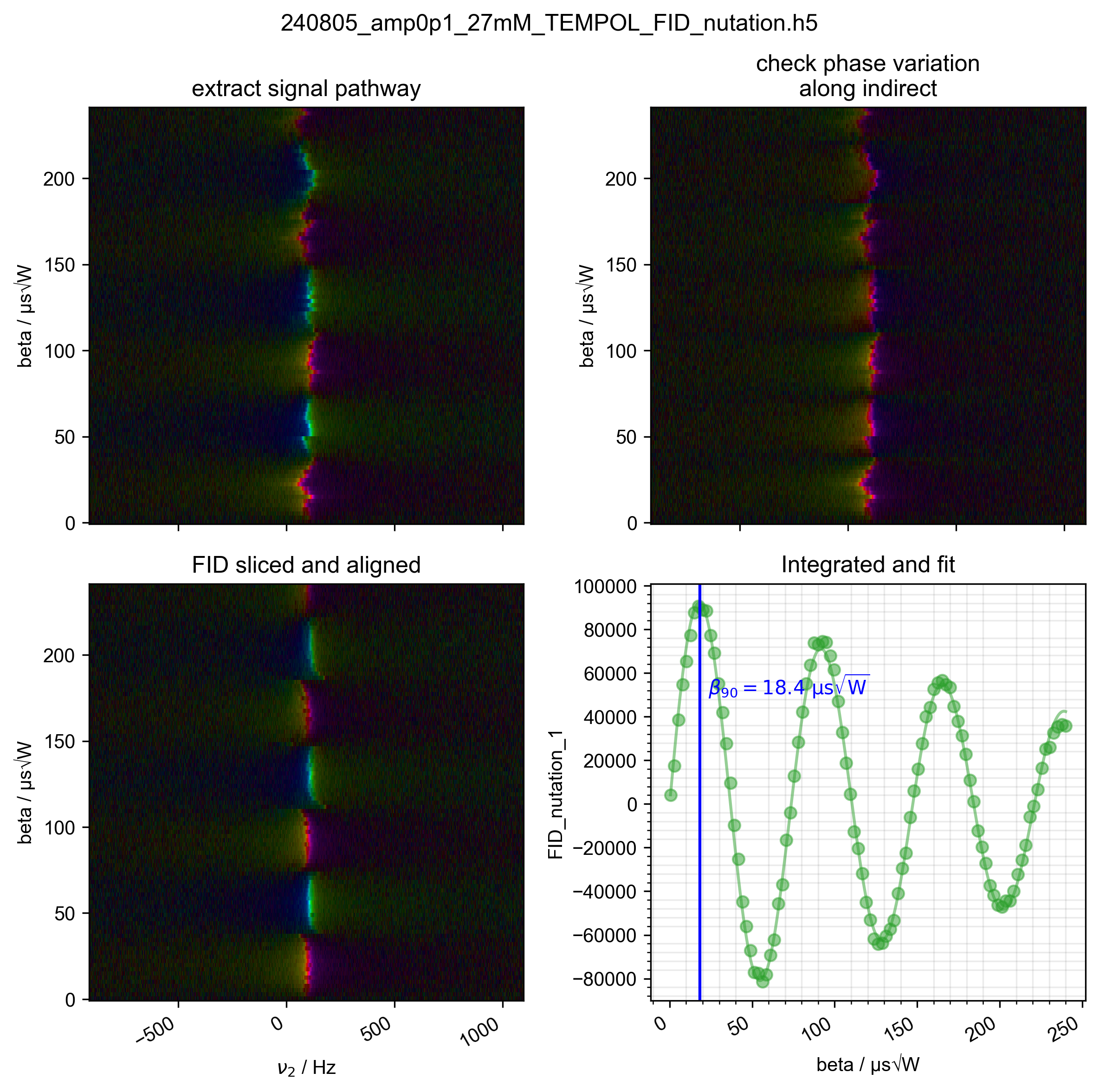
using postproc type spincore_FID_nutation_v1
1: autoslicing!
2: Raw Data with averaged scans
import pyspecdata as psd
import pyspecProcScripts as prscr
import sympy as sp
import sys, os
from numpy import r_

if "SPHINX_GALLERY_RUNNING" in os.environ and os.environ['SPHINX_GALLERY_RUNNING'] == 'True':
    sys.argv = [
        sys.argv[0],
        "FID_nutation_1",
        "240805_amp0p1_27mM_TEMPOL_FID_nutation.h5",
        "ODNP_NMR_comp/nutation",
    ]

slice_expansion = 5
assert len(sys.argv) == 4, "intended to be called with file info at cmdline"
s = psd.find_file(
    sys.argv[2],
    exp_type=sys.argv[3],
    expno=sys.argv[1],
    lookup=prscr.lookup_table,
)
print("using postproc type", s.get_prop("postproc_type"))
with psd.figlist_var() as fl:
    frq_center, frq_half = prscr.find_peakrange(s, fl=fl)
    signal_range = tuple(slice_expansion * r_[-1, 1] * frq_half + frq_center)
    if "nScans" in s.dimlabels:
        s.mean("nScans")
    s.set_plot_color(
        "g"
    )  # this affects the 1D plots, but not the images, etc.
    # {{{ generate the table of integrals and fit
    s, ax_last = prscr.rough_table_of_integrals(
        s, signal_range, fl=fl, title=sys.argv[2], echo_like=False
    )
    A, R, beta_ninety, beta = sp.symbols("A R beta_ninety beta", real=True)
    s = psd.lmfitdata(s)
    s.functional_form = (
        A * sp.exp(-R * beta) * sp.sin(beta / beta_ninety * sp.pi / 2)
    )
    prefactor_scaling = 10 ** psd.det_unit_prefactor(s.get_units("beta"))
    s.set_guess(
        A=dict(
            value=s.data.max(),
            min=s.data.max() * 0.8,
            max=s.data.max() * 1.5,
        ),
        R=dict(
            value=1e3 * prefactor_scaling, min=0, max=3e4 * prefactor_scaling
        ),
        beta_ninety=dict(
            value=20e-6 / prefactor_scaling,
            min=0,
            max=1000e-6 / prefactor_scaling,
        ),
    )
    s.fit()
    # }}}
    # {{{ show the fit and the β₉₀
    fit = s.eval(500)
    fl.plot(fit, ax=ax_last)
    ax_last.set_title("Integrated and fit")
    beta_90 = s.output("beta_ninety")  # because we allow
    #                                   rough_table_of_integrals to convert to
    #                                   human units (with prefactors), this
    #                                   will be in human units
    ax_last.axvline(beta_90, color="b")
    ax_last.text(
        beta_90 + 5,
        5e4,
        r"$\beta_{90} = %0.1f\ \mathrm{μs \sqrt{W}}$" % beta_90,
        color="b",
    )
    # }}}
    ax_last.grid()
Total running time of the script: (0 minutes 4.652 seconds)